Showing posts with label P5-6 Systems. Show all posts

27 April 2019

How is brightness affected by batteries and bulbs connected in series?


In this video, I shared a method to help students remember how the brightness in each light bulb is affected by batteries and bulbs connected in series. This topic is in the theme Systems, Upper Block Science.
Please consider subscribing to watch more!

Opening and ending music pieces by Lynn Koo.
https://soundcloud.com/lynnkoo
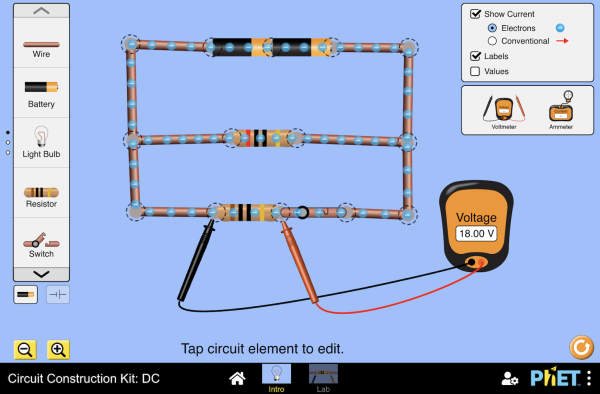
Click below for a circuit construction simulation kit.
Circuit Construction Kit: DC
Click to Run

20 April 2019

Explaining an electric bell circuit to a child


In this video, I explained an electric bell circuit to a child. This topic is in the theme Systems, Upper Block Science.
Please consider subscribing to watch more!

Opening and ending music pieces by Lynn Koo.
https://soundcloud.com/lynnkoo

Click below for a circuit construction simulation kit.
Circuit Construction Kit: DC
Click to Run

05 April 2019

Electric current for primary school science


Electric current (addressing misconception) for
Upper Block Science > Systems > Electrical Systems
Please consider subscribing to watch more!

Opening and ending music pieces by Lynn Koo.
https://soundcloud.com/lynnkoo

Click below for a circuit construction simulation kit.
Circuit Construction Kit: DC
Click to Run

24 February 2019

09 March 2018

Activity 5.1

Most of you have identified the problems in the torches that were assigned to your groups respectively, but we were unable to consolidate the 3 different problems in class today. Here is a consolidation of possible problems:

Problem 1: The batteries are arranged wrongly.
Action taken: Arrange the batteries correctly.
How is it solved? The batteries are arranged in the correct order for electric current to flow through the circuit.

Problem 2: The bulb is broken / fused.
Action taken: Replace the bulb.
How is it solved? A working bulb allows electric current to flow through it.

Problem 3: The switch is loose.
Action taken: Tighten the switch.
How is it solved? The switch is connected properly to the rest of the circuit.

A torch is an electrical system. For a torch to give off light, all the parts of the torch must work together.

Virtual lab for electric circuits

We are using this virtual lab for Activity 5.3 today.

Circuit Construction Kit: DC - Virtual Lab
Click to Run

Feel free to explore the virtual lab at your own free time.

07 February 2018

A cut in the stem

This appears in a question in your topical worksheet on Plant Transport System.


The science teachers have carried out the experiment with red food dye and here's the result:

10 January 2018

Plant Transport System (Day 2)

The same stalk of celery used in Day 1, slightly slit and then torn apart to reveal the water-carrying tubes.

Taken in class right after the stalk was torn apart.


Taken in the staffroom after class.

Let's take a closer look.

Also see:
Plant transport system (Day 1)
Plant transport system (2016)

09 January 2017

Animal cells and plant cells

Today we learned about the different parts of animal cells and plant cells, and their functions.

05 August 2016

Leaf soaked in hot water

In Systems Workbook Activity 2.4 (page 15), we recalled that there are tiny openings found on the surfaces of the leaves.

Let's soak a leaf in a container of hot water and observe.


Observations:
  • There were many tiny bubbles on the leaf. 
  • There were more bubbles on the lower surface than on the upper surface.

01 August 2016

How your lungs work

This is the cartoon that I showed in class during science lesson on our respiratory system.

27 July 2016

Air and the respiratory system

Some of you requested for me to put this on my blog:


"The permanent gases in gas we exhale are 4% to 5% by volume more carbon dioxide and 4% to 5% by volume less oxygen than was inhaled."

You do not have to remember the percentage of each type of air that you breathe in and breathe out.

You need to know that the air we breathe in is composed of mainly nitrogen, followed by oxygen, and lastly small amount of carbon dioxide, water vapour and other gases.


For Activity 2.1 in your Systems Workbook, we watched this video about breathing into limewater today.


For Activity 2.3 in your Systems Workbook, we are going to make a model to show how our lungs work. Please prepare the following materials:
  • a plastic bottle (please ask an adult to cut away the bottom of the bottle)
  • 2 balloons
  • a straw
  • a rubber band
  • some plasticine
The following video shows us how the model can be prepared.

15 July 2016

Plant transport system

P5&6 Systems Workbook Activity 1.1 Part B

Page 2: Water transport in a split celery stalk

Page 3: Cut surfaces from the bottom of the stalk

Page 3: Cut surface from the top of the stalk

Observation: the leaves

Observation: different colours in the stem and leaves

Extra: You can tear the stem and see the water-carrying tubes inside!

Check this out!